 By Aditya Tiwari, Anshuman Enterprises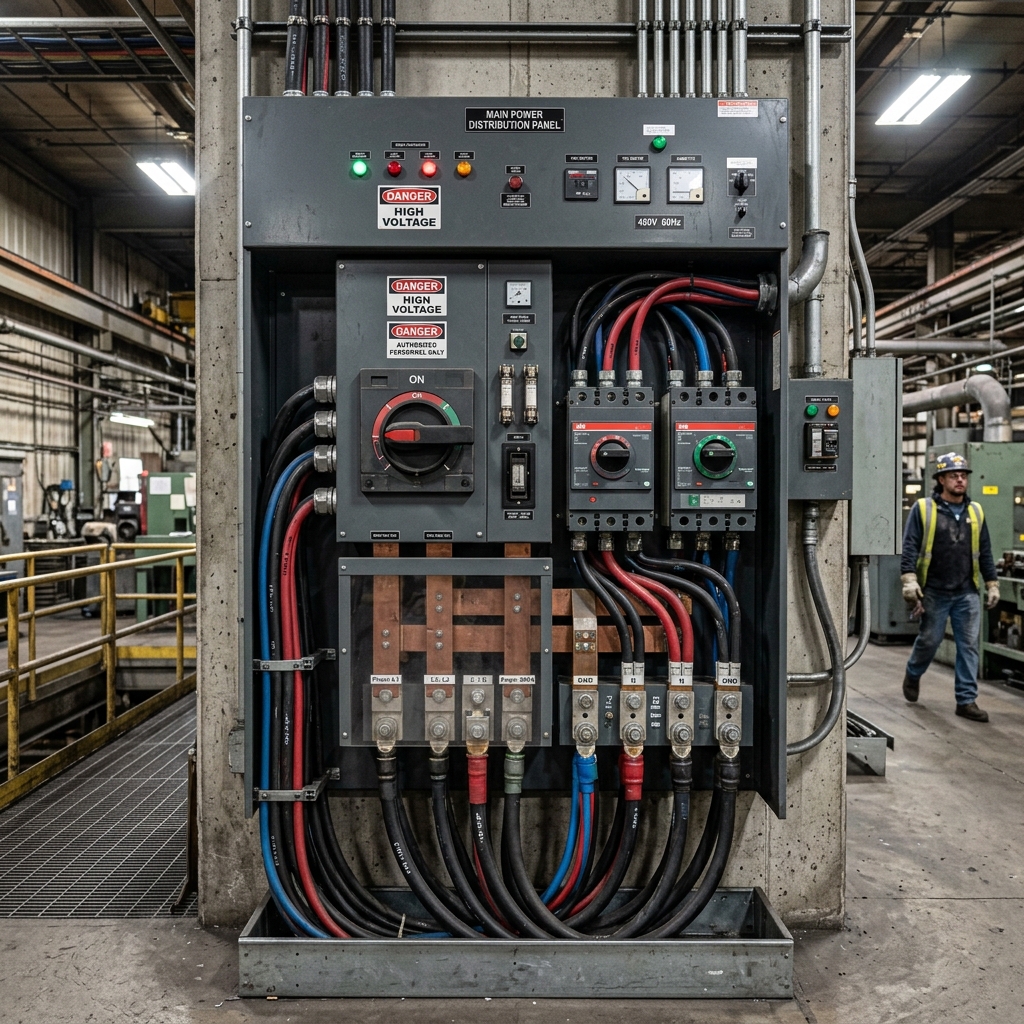
In a massive manufacturing facility, an electrical panel failure does not just mean the lights go out; it means the assembly line stops, raw materials perish, and millions of rupees are lost in unscheduled downtime.
Industrial Distribution Boards, commonly known as Main LT (Low Tension) Panels or Motor Control Centers (MCC), are the beating heart of any factory in Greater Noida and the Yamuna Expressway Industrial Area. These metal enclosures manage thousands of Amperes of 415-Volt 3-phase electricity, directing power to massive CNC machines, HVAC chillers, and conveyor belts.
In this massive 2000+ word technical guide by the master electrical contractors at Anshuman Enterprises, we will break down the science of Preventative Maintenance for heavy-duty panels. We will explore advanced thermography scanning, explain why a loose nut is the #1 cause of factory fires, and provide a comprehensive monthly and annual maintenance checklist to guarantee zero downtime for your facility.
Table of Contents
- ▸ 1. The Anatomy of an Industrial Distribution Board
- ▸ 2. Thermography (Infrared Scanning): Finding Hotspots Early
- ▸ 3. Tightening Torque: The #1 Cause of Electrical Fires
- ▸ 4. Cleaning and Dust Removal (Managing IP Ratings)
- ▸ 5. Testing RCDs and Earth Leakage Relays (ELR)
- ▸ 6. Creating a Preventative Maintenance Schedule
- ▸ 7. Safety First: The Importance of Arc Flash PPE
- ▸ 8. Expert Frequently Asked Questions (FAQs)
1. The Anatomy of an Industrial Distribution Board
Before you can maintain a panel, you must understand its components. An industrial panel is vastly more complex than a home breaker box.
- Air Circuit Breakers (ACB) / MCCB: The massive main switches that protect the incoming supply from the transformer. An ACB can safely interrupt faults up to 65kA (65,000 Amps).
- Copper Busbars: Instead of wires, huge solid copper or aluminum bars run down the spine of the panel. These carry the massive main currents to the individual breakers.
- Contactors & Relays: Electromechanical switches that use a low-voltage signal (like 24V from a PLC) to switch a massive 415V load (like a 100 HP motor).
- VFDs (Variable Frequency Drives): Electronic devices that control the speed and torque of AC motors by varying motor input frequency and voltage.
2. Thermography (Infrared Scanning): Finding Hotspots Early
The greatest enemy of an electrical panel is invisible to the naked eye: Heat. When a massive amount of current flows through a high-resistance point, it generates heat. Over months, this heat slowly melts the PVC insulation, chars the Bakelite breaker casing, and eventually erupts into an Arc Flash fire.
✅ The Power of Infrared Cameras
You cannot turn off the factory to check for heat. Therefore, professional contractors perform Thermography Scanning while the panel is fully energized and running at peak load. Using an industrial infrared camera (like a FLIR), the contractor scans the internal components. A loose connection or a failing contactor will show up on the screen as a bright red or white "hotspot," sometimes reading over 120°C. This allows the contractor to schedule a targeted repair during the weekend, rather than suffering an emergency breakdown on a Wednesday afternoon.
3. Tightening Torque: The #1 Cause of Electrical Fires
Why do hotspots form in the first place? Because of a physical phenomenon known as "Thermal Cycling."
When heavy machinery turns on, massive currents flow through the copper busbar joints and the heavy-duty lugs attached to the MCCBs. This current heats the metal slightly, causing it to expand. When the machinery is turned off at night, the metal cools and contracts. Over thousands of cycles, the steel bolts holding the copper joints together slowly vibrate loose.
A loose joint creates high electrical resistance, which creates massive heat, which creates an arc, which creates a fire.
💡 Expert Torque Strategy
A crucial part of annual maintenance is shutting down the main power and systematically retightening every single bolt in the panel using a calibrated Torque Wrench. Never over-tighten, as you will strip the brass threads on the breaker. Follow the exact Newton-Meter (Nm) torque specs provided by the manufacturer (e.g., Havells or L&T).
4. Cleaning and Dust Removal (Managing IP Ratings)
Indian factories are notoriously dusty. Cardboard fibers, cement dust, and metallic shavings from CNC machines are constantly airborne. If an industrial panel is poorly sealed (low IP rating), these conductive dust particles are sucked into the enclosure by the cooling fans.
When metallic dust settles across two exposed copper busbars, a high-voltage arc can jump across the dust, causing a catastrophic short circuit.
During maintenance, contractors must:
- Turn off all power (De-energize).
- Use an industrial vacuum cleaner to suck out the heavy debris at the bottom of the panel.
- Use a moisture-free air blower (never a standard air compressor, which spits out water droplets) to gently blow the fine dust out of the contactors and VFD heat sinks.
- Inspect and replace the foam air filters on the enclosure's exhaust fans.
Is your factory's main panel aging dangerously? Upgrade to a modern, IP65-rated distribution board built with genuine L&T switchgear. Contact us for a custom panel fabrication quote.
5. Testing RCDs and Earth Leakage Relays (ELR)
In an industrial setting, massive machines can develop microscopic earth leakages. If the metal chassis of a massive hydraulic press becomes energized, an operator touching it could be electrocuted instantly.
Industrial panels use Earth Leakage Relays (ELR) combined with Core Balance Current Transformers (CBCT) to monitor for leakage. During maintenance, contractors must inject a simulated fault current into the CBCT to ensure the ELR successfully trips the main breaker within the required 30 milliseconds. Simply pressing the "Test" button on the relay is not enough; a true secondary injection test proves the mechanical linkages actually work.
6. Creating a Preventative Maintenance Schedule
A reactive approach ("fix it when it breaks") is financial suicide for a factory. You must implement a proactive schedule.
The Master Maintenance Schedule
- Monthly: Visual inspection of panel exterior. Check cooling fans and replace dirty intake filters. Check digital meters for phase imbalances.
- Quarterly: Perform full-load Thermography (Infrared) scanning. Check for unusual buzzing or humming noises from contactors.
- Bi-Annually: Test all RCDs and ELRs via primary or secondary injection. Clean out dust using vacuum and dry air.
- Annually (Complete Shutdown): De-energize the entire facility. Perform torque-wrench tightening of all busbar bolts and main breaker lugs. Perform Megger (Insulation Resistance) testing on main incoming cables. Clean internal contacts of large Air Circuit Breakers (ACBs).
7. Safety First: The Importance of Arc Flash PPE
Working on a 415V, 2000-Amp industrial panel is inherently lethal. If a contractor accidentally drops a metal wrench across the live busbars, it creates an Arc Flash—an explosive blast of plasma that reaches 19,000°C (hotter than the surface of the sun).
Professional contractors never open a live industrial panel in a simple cotton shirt. They are required to wear specialized Arc Flash Personal Protective Equipment (PPE). This includes a heavy Kevlar/Nomex flash suit, thick rubber insulated gloves (rated for 1000V), and an arc-rated face shield to protect against flying molten copper.
8. Expert Frequently Asked Questions (FAQs)
Why does a contactor make a loud buzzing noise? +
A buzzing contactor usually means that dust or debris has found its way between the magnetic core faces inside the unit, preventing them from closing tightly. This causes the coil to rapidly vibrate. The contactor must be dismantled, cleaned, and reassembled.
What is Megger testing and why is it important? +
Megger testing (Insulation Resistance Testing) involves shooting 500V or 1000V DC through a thick cable to ensure the rubber insulation hasn't degraded. If a massive underground cable has micro-cracks letting moisture in, a Megger test will detect it long before it causes a massive short circuit in the panel.
Can I use water or standard cleaners to clean the panel? +
Never. Water or liquid solvent cleaners will destroy the electronics and leave conductive residues that cause short circuits. Specialized dielectric aerosol contact cleaners can be used sparingly on specific components, but a dry vacuum and dry compressed air are the standard methods.
Secure Your Factory Uptime
Don't wait for a catastrophic failure to shut down your production line. Book a comprehensive Annual Maintenance Contract (AMC) with the industrial experts at Anshuman Enterprises.
Get an AMC Maintenance Quote