 By Aditya Tiwari, Anshuman Enterprises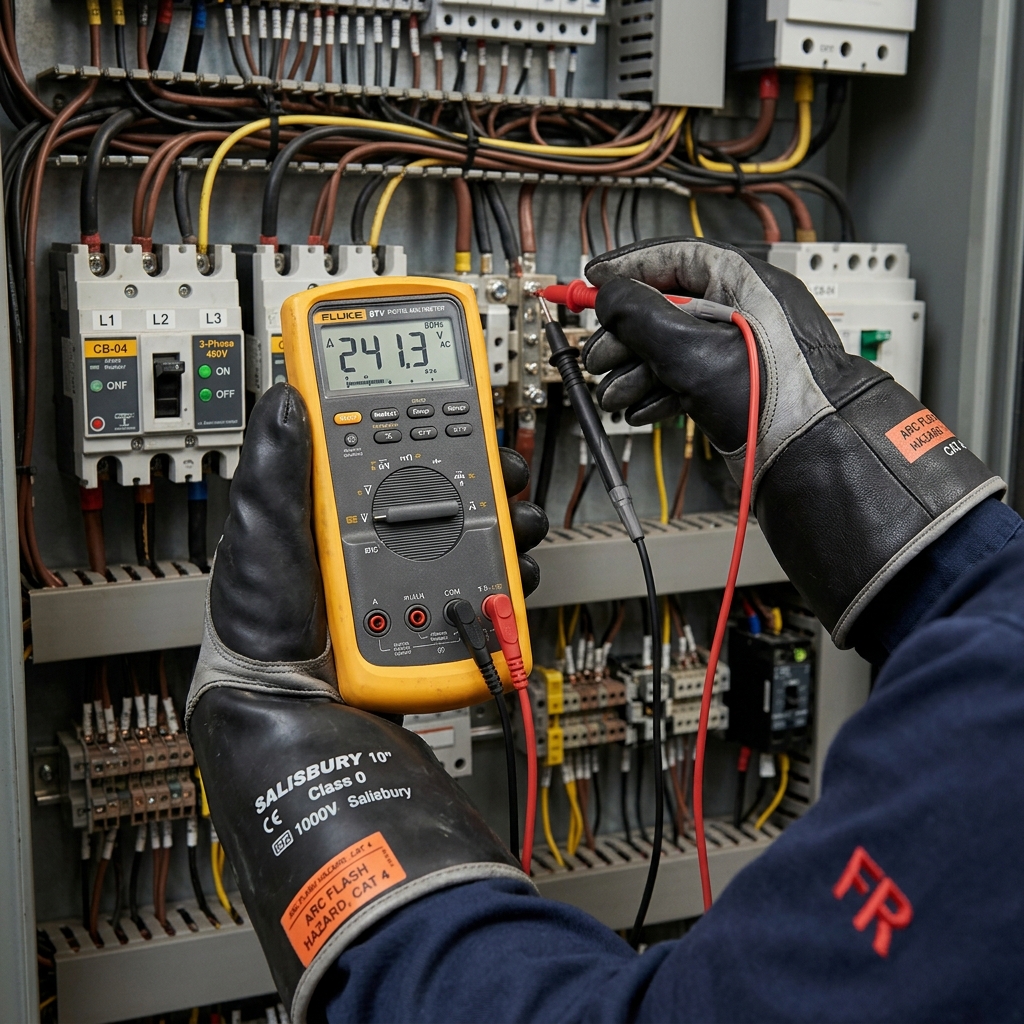
Electricity is an invisible, silent, and entirely lethal force. Unlike a leaking water pipe that you can see, or a gas leak that you can smell, a live 230-volt copper wire looks exactly the same as a dead one. If an electrical contractor touches it by mistake, the consequences are instantly catastrophic.
Every year across India, hundreds of preventable accidents occur simply because electricians try to save money by skipping crucial Personal Protective Equipment (PPE) or using cheap, uncertified tools. When you are standing on an aluminum ladder dealing with a live commercial distribution board, a standard pair of rubber dishwashing gloves will not save your life.
In this extensive 2000+ word safety guide by Anshuman Enterprises, we will explore the 5 absolutely non-negotiable safety tools that every professional electrician must have in their toolkit. We will break down the science of Voltage Classes for gloves, why you need VDE certified hand tools, and how a simple LOTO kit can prevent fatal accidents on large industrial sites.
Table of Contents
- ▸ 1. Insulated Rubber Gloves (Understanding Voltage Classes)
- ▸ 2. Non-Contact Voltage Testers (The First Line of Defense)
- ▸ 3. Dielectric Safety Footwear (Electrical Hazard Boots)
- ▸ 4. VDE Certified Insulated Hand Tools
- ▸ 5. Lockout/Tagout (LOTO) Kits (For Industrial Safety)
- ▸ 6. Bonus: Arc Flash Face Shields (For Panel Work)
- ▸ 7. Expert Frequently Asked Questions (FAQs)
1. Insulated Rubber Gloves (Understanding Voltage Classes)
Your hands are the primary contact point with electrical systems. A standard pair of leather or cotton gloves provides zero protection against electrical current. Even standard thick rubber gloves are useless, as high voltage can easily arc straight through microscopic pores in cheap rubber.
Professional electricians must use specialized Dielectric Rubber Gloves. These are strictly categorized by "Voltage Classes" set by international standards like ASTM D120.
- Class 00: Tested up to 2,500V. Safe for maximum use of 500 Volts AC. This is the standard class required for all residential and light commercial work (230V/415V).
- Class 0: Tested up to 5,000V. Safe for maximum use of 1,000 Volts AC. Required for heavy industrial panels and solar DC installations.
- Class 2: Tested up to 20,000V. Safe for use up to 17,000 Volts AC. Used by utility workers dealing with high-tension street transformers.
⚠ The Pin-Hole Danger
A microscopic pin-hole in an insulated glove can allow 230V to arc directly into your skin. Before every single job, electricians must "roll-test" their gloves. Trap air inside the glove and roll the cuff down tightly. If you hear or feel air escaping, the glove is compromised and must be thrown in the trash immediately.
Furthermore, rubber degrades when exposed to UV light, oil, and sharp edges. Therefore, electricians must always wear a pair of thin leather "Protector Gloves" over the rubber gloves to prevent physical punctures from copper wire strands.
2. Non-Contact Voltage Testers (The First Line of Defense)
The golden rule of electrical work is: "Always assume it is live until proven dead." You should never touch a wire just because the switch is turned off. A previous amateur electrician might have accidentally wired the switch to the Neutral line instead of the Phase line, leaving the ceiling wire constantly live.
A Non-Contact Voltage (NCV) Tester (often called a "Sniffer" or "Volt Pen") is a small, pen-like device that detects the electromagnetic field generated by AC voltage without requiring you to actually touch the bare copper wire.
✅ How to Use an NCV Safely
1. Test the NCV on a known live source (like a plugged-in lamp) to ensure the batteries work.
2. Touch the tip of the pen to the plastic insulation of the suspect wire. If it beeps and flashes red, the wire is live.
3. Finally, test the NCV on the known live source again to ensure it didn't break during step 2.
Brands like Fluke, Klein Tools, and Milwaukee manufacture professional-grade NCVs that also indicate varying voltage levels. Never rely on cheap ₹50 neon test pens; they require you to physically touch the live wire and act as the ground path, which is extremely dangerous if the resistor inside the pen fails.
3. Dielectric Safety Footwear (Electrical Hazard Boots)
For electricity to kill you, it must flow through your body. It enters through your hands and frantically tries to find the fastest path to the Earth, which is usually through your feet.
If you are standing barefoot on a wet concrete floor, your body has very low resistance to the ground. A 230V shock will be massive and instantly fatal. If you are wearing standard steel-toed construction boots, the metal toe cap can actually conduct electricity if a live wire drops on your foot.
Electricians must wear Electrical Hazard (EH) Rated Boots. These boots feature thick, specially formulated dielectric rubber soles that isolate your body from the ground, blocking the path of the current. They also use composite (fiberglass or hardened plastic) toe caps instead of steel, ensuring no metal is exposed.
4. VDE Certified Insulated Hand Tools
Wrapping a standard steel screwdriver in cheap black electrical tape does not make it an insulated tool. Electrical tape wears out quickly and slides off, exposing the steel shaft. If that steel shaft accidentally touches the metal casing of a live distribution board, you will create a dead short circuit in your hand.
Professional electricians exclusively use VDE Certified Insulated Tools. VDE (Verband der Elektrotechnik) is a stringent German testing institute. A VDE certified plier or screwdriver has a thick, dual-layer injection-molded plastic coating over the entire metal shaft.
- They are individually tested in a water bath at 10,000 Volts to guarantee safety up to 1,000 Volts AC.
- They undergo impact testing at -25°C to ensure the plastic insulation won't shatter if dropped in cold weather.
- The dual-layer design usually features a bright yellow inner layer and a red outer layer. If you can see the yellow layer, it means the outer red insulation has worn away and the tool is no longer safe to use.
Equip your contracting team with genuine safety gear. Explore our professional tools catalog featuring authentic Taparia and Stanley insulated tool kits.
5. Lockout/Tagout (LOTO) Kits (For Industrial Safety)
In massive factories, an electrician might turn off the main MCCB on the ground floor, and then walk up to the 4th floor to perform maintenance on a heavy motor. While they have their hands inside the motor, a well-meaning factory worker on the ground floor might see the MCCB is off, assume it tripped accidentally, and turn it back on. The electrician on the 4th floor is instantly electrocuted.
To prevent this, international safety laws mandate Lockout/Tagout (LOTO) procedures.
The LOTO Procedure
- Lockout: When the electrician turns off the MCCB, they place a physical red plastic hasp over the breaker switch and secure it with a heavy brass padlock. They take the only key with them. It is now physically impossible for anyone else to turn the breaker on.
- Tagout: A bright warning tag is attached to the padlock stating "DANGER: DO NOT OPERATE. Electrician at Work." with the electrician's name, phone number, and the date.
6. Bonus: Arc Flash Face Shields (For Panel Work)
While fixing a socket doesn't require face protection, working on massive 415V, 1000-Amp industrial panels introduces the risk of an Arc Flash. An Arc Flash is an explosive blast of superheated plasma (reaching 19,000°C) caused by a short circuit across heavy busbars.
Standard safety glasses will instantly melt to the contractor's face during an Arc Flash. Electricians working on live LT panels must wear specialized Arc-Rated Face Shields infused with nanoparticle technology that absorbs the blinding ultraviolet light and deflects the immense heat of the blast.
7. Expert Frequently Asked Questions (FAQs)
Why shouldn't I use a cheap neon test pen? +
A neon test pen requires you to place your finger on the metal cap at the back. This uses your own body to complete the circuit to the ground, causing the bulb to light up. If the tiny resistor inside the cheap plastic pen fails, the full 230V current will shoot straight through your finger, causing a fatal shock. Always use Non-Contact Voltage (NCV) testers instead.
Do insulated rubber gloves have an expiration date? +
Yes. By law, Class 0 and above dielectric rubber gloves must be sent to an accredited laboratory for electrical re-testing every 6 months, even if they have never been worn and are sitting in a box. Rubber degrades naturally over time.
Can I wear a metal watch while doing electrical work? +
Absolutely not. Rings, metal watches, and dangling gold chains are strictly prohibited. If your metal watch strap accidentally brushes across two live terminals, it will instantly turn red-hot, causing third-degree burns to your wrist in milliseconds.
Hire Certified Safety Professionals
Don't risk your facility's safety with untrained handymen. Anshuman Enterprises employs fully certified contractors equipped with world-class PPE for all industrial projects.
Book a Professional Contractor